If you searched for how to apply for TETFund scholarship, you are in the right place. The TETFund scholarship, also called the Academic Staff Training and Development program, is not open to every student in Nigeria.
It’s mainly for academic staff, meaning lecturers and teaching staff, at public universities, polytechnics, and colleges of education in Nigeria. To apply, you must already be a confirmed academic staff member at one of these schools, gain admission into a Master’s or PhD program, and then apply through your school, not directly to TETFund.
Let us break this down piece by piece so you understand exactly what to do.
What Is the TETFund Scholarship?
The TETFund scholarship is a fund given by the Tertiary Education Trust Fund to help lecturers in Nigerian public schools further their education.
TETFund is a government body that collects a small tax from companies in Nigeria and uses that money to support public tertiary education. Part of that money goes into training lecturers so they can get higher degrees such as a Master’s or a Doctorate degree.
This scholarship is often called AST&D, which stands for Academic Staff Training and Development. Some older documents also call it TSAS, which means TETFund Scholarship Award Scheme.
Both names point to the same thing: money given to lecturers to study for higher degrees.
The goal is simple: Nigeria wants more lecturers to hold Master’s and PhD degrees because this raises the quality of teaching in schools. So instead of lecturers paying for their own postgraduate studies, TETFund pays for it, as long as the lecturer meets the rules.
Who Can Apply for the TETFund Scholarship?
This is the part many websites get wrong. A lot of pages online tell regular undergraduate students that they can apply for a TETFund scholarship. This is not correct.
The TETFund scholarship under the AST&D program is built only for staff, not for students who are still doing their first degree.
To apply for the TETFund scholarship, you must meet these points:
You must already be a full-time academic staff member at a Nigerian public university, polytechnic, or college of education. This means you already work there as a lecturer or teaching staff, and your job has been confirmed, not just on a trial period.
You must have gained admission to study for a Master’s degree or a Doctorate. Note that TETFund does not give admission. You must first apply and get accepted into a school on your own, then bring that admission letter to apply for the scholarship money.
You must be studying in a field that is useful to your department and to the school. Your Head of Department has to support your application in writing.
You must not already hold a second Master’s degree or a second Doctorate through TETFund funding. The rule is there so more staff members get a chance, instead of one person collecting the scholarship many times.
Right now, TETFund mostly funds Master’s and Doctorate studies inside Nigeria. Foreign study sponsorship has been paused, so most schools now ask staff to study in Nigerian universities only.
Note that this can change from year to year, so always check with your own school before you plan your studies abroad.
If you are a regular student and not a staff member, the TETFund scholarship under this program is not for you right now. Do not waste time or money on any site or agent asking you to pay to apply, since that is a sign of a scam.
Later in this post, I’ll show you other alternatives to get a scholarship if you are a student and not staff.
Why Do So Many Websites Say TETFund Is for Undergraduates?
You may be wondering why other blog posts claim TETFund gives money to undergraduates. There are a few reasons for this mix-up:
First, some writers confuse TETFund with NELFUND, which is the Nigerian Education Loan Fund.
NELFUND is a newer program that gives loans to Nigerian students, including undergraduates, to help pay school fees and upkeep costs.
NELFUND and TETFund are two different bodies with two different goals. TETFund trains lecturers. NELFUND lends money to students.
Second, TETFund does fund some things that touch student life, such as building lecture halls, buying books for libraries, and supporting research. But this is not the same as giving a personal scholarship to an undergraduate student.
Third, some websites simply copy old or wrong information from each other without checking the real TETFund guideline documents. This is why you see the same wrong claim repeated across many pages.
Knowing this difference will save you time. If you are a student looking for school fee support, look up NELFUND instead. If you are a lecturer wanting to study for a higher degree, then the TETFund scholarship is the right one for you.
Read Also: 7 Undergraduate Scholarships in Nigeria with No Application Fee.

Step by Step: How to Apply for TETFund Scholarship
Now let us go through the real steps to apply. Keep in mind that TETFund does not collect applications directly from individual lecturers.
Instead, your own school collects applications first, checks them, then sends the approved list to TETFund. So your first stop is always your school, not the TETFund website.
Step 1: Gain admission into a Master’s or PhD program
Before you think about the scholarship, you need admission. Apply to a Nigerian university that offers the course you want to study.
Once you are given admission, you will receive an admission letter. This letter must clearly show your course of study, the school fees, and the date your program will start. Without this letter, you cannot move forward.
Step 2: Check your school’s call for TETFund nominations
Public schools in Nigeria usually put out a public notice, often on their website or notice board, when TETFund opens a new round of nominations.
This notice tells staff how to submit their documents and when the deadline is. Watch your school’s academic planning office, staff email, or official website for this announcement, since dates change every year.
Step 3: Collect the required documents
Once you see the notice, start gathering your papers. We list the full document set in the next section, so you do not miss anything.
Step 4: Get a letter of support from your Head of Department
Your application needs a letter from your Head of Department, and this letter should be signed by the Dean of your Faculty too.
This letter tells TETFund that your department agrees you should study this course, and that it will benefit your teaching work later.
Step 5: Submit your documents to your school’s TETFund desk
Take your full document set to the office in charge of TETFund matters in your school. This is often called the Academic Planning Unit or a similar name. They will check that your papers are complete and correct.
Step 6: Wait for your school to review and forward your name
Your school will look at everyone who applied, then choose who to forward to TETFund based on need, discipline, and available slots. Not everyone who applies gets forwarded, since schools often have a limited number of slots each year.
Step 7: TETFund reviews the forwarded list
Once TETFund receives the list from your school, they check it against their own rules and budget. If you are approved, your school will inform you, and the process to release your scholarship funds will begin.
Step 8: Sign the bond and start your program
Before funds are released, you may be asked to sign an agreement, sometimes called a bond, that says you will return to serve your school after finishing your studies.
This is common with staff development programs, since the school wants to be sure it benefits from your extra training.
Check Also: 15 Scholarship Opportunities for Nigerian Students
7 Documents You Need for the TETFund Scholarship
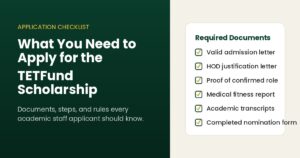
Here is a detailed look at the documents schools commonly ask for, along with why each one matters.
1. Admission letter: This proves you have a real place to study. It must show your full course name, when the course begins, and the fees you will pay. A letter that only says you are on a waiting list will not be accepted.
2. Letter of justification from your Head of Department: This shows your department supports your choice of course. It should explain how the course will help your teaching role and your department’s growth.
3. A valid staff email address from your school: Some schools now require staff to use their official school email address for all TETFund-related communication. This helps prevent fraud and mix-ups with fake emails.
4. Medical fitness report: Since studying for a Master’s or PhD can be demanding, schools often ask for proof that you are in good health before they approve your sponsorship.
5. Evidence of confirmed appointment: You need to show proof that you are not on probation, but a confirmed staff member of your school.
6. Academic transcripts and certificates: These prove your past qualifications and show you are ready for the next level of study.
7. Passport photographs and a completed nomination form: Most schools provide a specific TETFund nomination form that you must fill out by hand or online, along with recent passport-size photos.
Advice: Remember to always ask your school’s TETFund office for the exact current list, since some details can change from year to year. Do not assume last year’s list should be the same this year.
Common Mistakes That Make People Miss This Scholarship.
Many lecturers lose their chance at the TETFund scholarship not because they are unqualified, but because of small errors.
Here are mistakes to watch for:
Waiting too long to apply. Some staff wait until the last day to submit documents, then find out one paper is missing. Start early so you have time to fix any problem.
Applying with a course that is not useful to the department. If your course of study has little link to your teaching work, your Head of Department may not support it, and your school may not forward your name.
Sending an admission letter that is not final. A conditional admission or an offer that is not fully confirmed may be rejected. Always confirm your admission fully before applying.
Ignoring the local study rule. Some lecturers plan to study abroad without checking that TETFund is currently funding foreign study. Always confirm the current funding rule with your school before making travel plans.
Not following up after submission. Papers can get lost in busy offices. Check back with your school’s TETFund desk from time to time to make sure your file is still moving forward.
Trusting agents who promise fast approval for a fee. No one can legally speed up your TETFund approval by taking money from you outside your own school’s official process. Report anyone who asks for payment to fast-track your scholarship.
When Does TETFund Open Applications?
TETFund does not use one fixed date every year for the AST&D scholarship. Calls for nomination usually come out once or more each year, and the exact month can shift.
Your best method is to check your school’s official website and notice boards often, especially close to the start of a new academic session.
Many schools post their calls between the middle of the year and the start of a new session, but this is not a strict rule, so do not wait for a fixed month before you start preparing your documents.
Also See: Scholarships, Internships, and Grants for Students in Nigeria.

What Happens After You Submit Your Application?
Once you submit your papers, your school’s Academic Planning Unit checks everything, sometimes calling you back if something is missing.
After that, your name goes on a list sent to TETFund. TETFund studies this list based on how much money it has that year and how many slots each school gets. Not every approved name gets funded the same year, since the fund has limited money to share across many public schools in Nigeria.
If you are picked, your school will contact you, usually through your official staff email or a letter. You may then need to sign a bond agreeing to serve your school for a set number of years after your studies.
Also note that TETFund scholarship money is often paid in parts, not all at once, and tied to your progress in the program, such as when you complete each session or level of your course.
6 Tips for Getting the TETFund Scholarship
1. Pick a course that exactly links to your current teaching role, since this makes it easier for your Head of Department to support you.
2. Keep your documents ready ahead of time, even before your school announces a new call. This way, you are not rushing when the application opens.
3. Talk to senior colleagues in your department who have gone through the process before. They can tell you small details that are specific to your school.
4. Stay in close contact with your school’s Academic Planning Unit. Do not just submit and disappear. Ask politely for updates now and then.
5. Choose a Nigerian university for your studies unless your school confirms that foreign sponsorship is currently active, since rules on this can change.
6. Apply early within the time given, rather than close to the deadline, as early applications give your school more time to review your file properly.
What If You Are Not an Academic Staff Member?
If you are a regular student, not a lecturer, the TETFund scholarship under AST&D is not built for you. But you still have other paths worth trying.
NELFUND: This is the Nigerian Education Loan Fund, made for students, including undergraduates, in public tertiary schools. It gives loans for tuition and upkeep, and you pay it back later once you are working.
This is likely the option many people were actually thinking of when they searched for a TETFund scholarship for students.
State government scholarships: Many state governments in Nigeria run their own scholarship boards for indigenes studying at various levels. Check your own state’s scholarship board website or office for open calls.
School-based scholarships and bursaries: Some universities and polytechnics run their own bursary schemes for students with strong grades or financial need. Ask your student affairs office.
Private and corporate scholarships: Many banks, oil companies, and private foundations in Nigeria give scholarships to undergraduates each year. These often have their own separate application windows, so watch for calls throughout the year.
Also Read: 7 Grant Opportunities for Young Entrepreneurs in Nigeria.
Frequently Asked Questions About the TETFund Scholarship
Can an undergraduate student apply for the TETFund scholarship?
No. The TETFund scholarship under AST&D is for confirmed academic staff at Nigerian public tertiary institutions who already have admission to a Master’s or Doctorate program. Undergraduate students should look into NELFUND or other student-focused scholarships instead.
Do I apply to TETFund directly?
No, you do not send your papers straight to TETFund. You submit your documents through your own school’s Academic Planning Unit, and your school forwards approved names to TETFund.
Does TETFund pay for study abroad?
At the moment, most funding is limited to study inside Nigeria, since foreign sponsorship has been paused. Always confirm the current rule with your own school before making any travel plans, since this can change.
How much money does the TETFund scholarship give?
The amount changes based on your course of study and level. Science-based courses at both Master’s and Doctorate level often receive a higher yearly amount than other courses, but exact figures can change, so always confirm current rates through your school.
Is the TETFund scholarship free to apply for?
Yes. There is no official fee to apply for the TETFund scholarship through your school. If anyone asks you to pay money to guarantee approval, that is very likely a scam, and you should report it.
What happens if I change my course after getting the scholarship?
You are not allowed to change your course or your school after approval. Doing so can lead to your scholarship being withdrawn, and you may be asked to refund any money already given.
Can I apply for a second Master’s or Doctorate through TETFund?
No. If you have already received TETFund sponsorship for a Masters or Doctorate, you cannot apply again for the same level of study.
What if my school has not announced a TETFund call this year?
Keep checking your school’s website and notice boards, and ask your Academic Planning Unit directly. Calls do not follow one fixed date every year, so staying in touch with your school is your best method.
Conclusion
The TETFund scholarship is a useful support for lecturers who want to grow their career through a Masters or Doctorate degree. But it is not a general scholarship open to every student, and knowing this early will save you time and stress.
Now that you have learned how to apply for TETFund scholarship, if you are staff, focus on getting admission, gathering all needed documents, and staying close to your school’s Academic Planning Unit through the whole process.
And if you are a student, look toward NELFUND and other scholarship options built for you instead.
Overall, note that getting a TETFund scholarship takes patience and correct paperwork more than luck. Hence, you should prepare early, follow your school’s exact instructions, and keep asking questions until you are sure your application is complete.

Gloria is the founder of LearnAndEarn, where I write about personal finance, side hustles, and funding opportunities for young Nigerians navigating a tough economy on a student or entry-level budget.
I have used and tested Nigerian fintech apps including OPay, PiggyVest, Cowrywise, and Bamboo firsthand, and have helped readers track down scholarships, grants, and remote income opportunities since 2020.
My goal is simple: cut through the noise and scam-heavy corners of “make money online” content with information I personally verified. And when I am not researching the next savings app, skills to learn, or scholarship deadline, I’m answering reader questions in the comments, because I believe financial advice should be tested, not just repeated.
Got a question for me? Reach out here.